



.png)
Abstract
Replacing a lateral incisor in a thin biotype can feel like threading a needle: the margin for error is small, the patient’s expectations are high, and soft-tissue management is everything. This case follows a 75-year-old ASA II female who presented with a fractured #22 (12 weeks post-extraction and prior bone regeneration) and received an immediate temporary restoration with a MultiNeO™ implant powered by NiNA™ in D4 bone. The plan combined implant placement with vertical and horizontal soft-tissue augmentation and immediate non-functional loading to protect early healing.
Preoperative context and planning
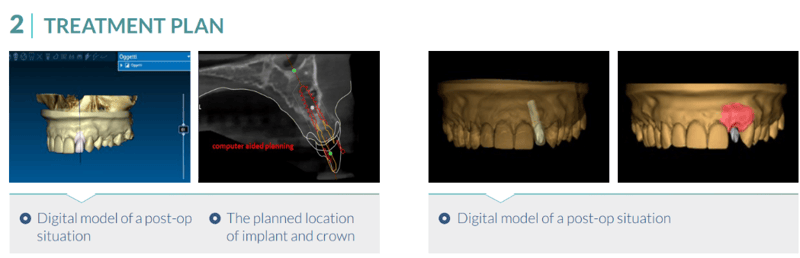
Following extraction and augmentation, the site still lacked volume in the papilla and buccal aspects—an esthetic red flag. Digital planning was used to define the intended three-dimensional position of both implant and crown.
Implant selection & dimensions. A MultiNeO™ implant (Ø3.75 mm, L10 mm) was used, matched to the narrow lateral incisor envelope while maintaining a restorative path aligned to the planned emergence profile.
Surgical and immediate restorative steps
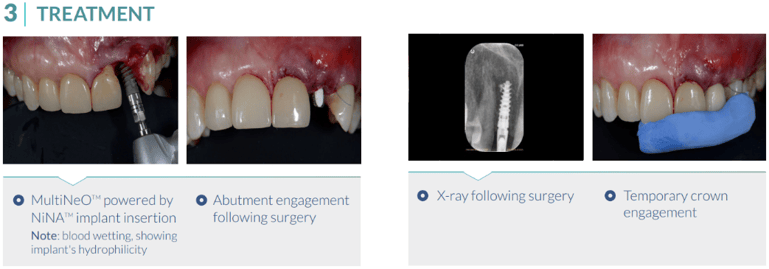
Insertion and surface behavior. Intraoperative blood wetting demonstrated the NiNA™ implant’s nano, super-hydrophilic surface - useful in low-density (D4) bone to support early biological interactions.
Soft-tissue strategy. Given the cervical volume deficiency, combined vertical and horizontal soft-tissue augmentation accompanied placement to build the peri-implant scaffold for later esthetics.
The Non-Loading protocol. The team opted for immediate non-functional loading-provisionally restoring without occlusal contact to protect the bone-implant interface in the early phase. The temporary crown was engaged after surgery and documented radiographically.
Postoperative course and outcomes
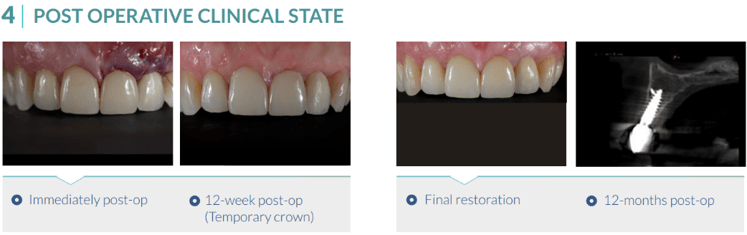
Short-term. The immediate postoperative status and the 12-week temporary crown phase are recorded; by three months, soft-tissue maturation around the provisional supported a stable cervical contour.
Long-term. The case concludes with a definitive restoration at the 12-month mark in the esthetic zone, indicating a stable soft-tissue frame and functional result over one year.
Attribution. Clinical protocol and documentation by Prof. Luigi Canullo (Italy).
Why this workflow matters?
- Correct positioning guided by a digital plan helps maintain restorative space and emergence for later soft-tissue support—especially critical for lateral incisors.
- Immediate non-functional loading should be considered when primary stability and soft-tissue management allow, helping the patient transition with a fixed provisional while keeping function conservative.
- A nano super-hydrophilic surface (NiNA™) can add early biologic wetting at placement, a useful feature when working in D4 bone.
Professional Value: Practical Tips
- Plan prosthetically backward. Start with the crown position and work back to the osteotomy—digita modeling helps ensure the implant axis, platform depth, and restorative components align with esthetic goals.
- Shape soft tissues early. Use a provisional contour that supports papillae and the buccal profile from day one. Pair with connective-tissue augmentation when cervical thickness is lacking to protect mid-facial levels over time.
- Apply immediate non-functional loading. Keep the provisional out of occlusion during the early period to reduce micromotion risk in lower-density bone. Document with postoperative radiographs to track stability.
Alpha-Bio Tec supports implant workflows with an education ecosystem (academy, online education, speaker community) and a portfolio spanning implant, prosthetic, surgical, digital, and regenerative solutions—useful for coordinating surgical and provisional steps in cases like this.
Conclusion
In an esthetic-zone demonstrating D4 bone, this case shows how careful planning, soft-tissue augmentation, and immediate non-functional loading around a MultiNeO™ implant powered by NiNA™ can provide a safe path to function and esthetics over 12 months. For more case-based learning and to explore our implant and prosthetic product lines that support similar implant workflows, visit Alpha-Bio Tec’s resource center and education channels.
Learn more about the MultiNeO™ Implant and NiNA™ Technology here: Alpha-Bio Tec Academy.
.jpeg)
.jpeg)
.png)
.png)
.jpeg)